
Two open-weight models from Chinese labs matched or beat every generally available closed model A Security tested as an AI attacker. DeepSeek V4.1 Flash 1017 found 93% of the validated vulnerabilities. They are also cheaper. DeepSeek v4.1 cost $0.81 per finding, 12 to 39 times less per finding than the closed models. GLM 5.3 was the only model in the test to find every vulnerability at least once across three runs. Anyone can download the weights for both, with no verification and no content filters.
Key Findings
- DeepSeek V4.1 Flash found 93% of the validated vulnerabilities in every run, the highest in the set. GLM 5.3 found 86% per run and was the only model to find every vulnerability at least once across three runs.
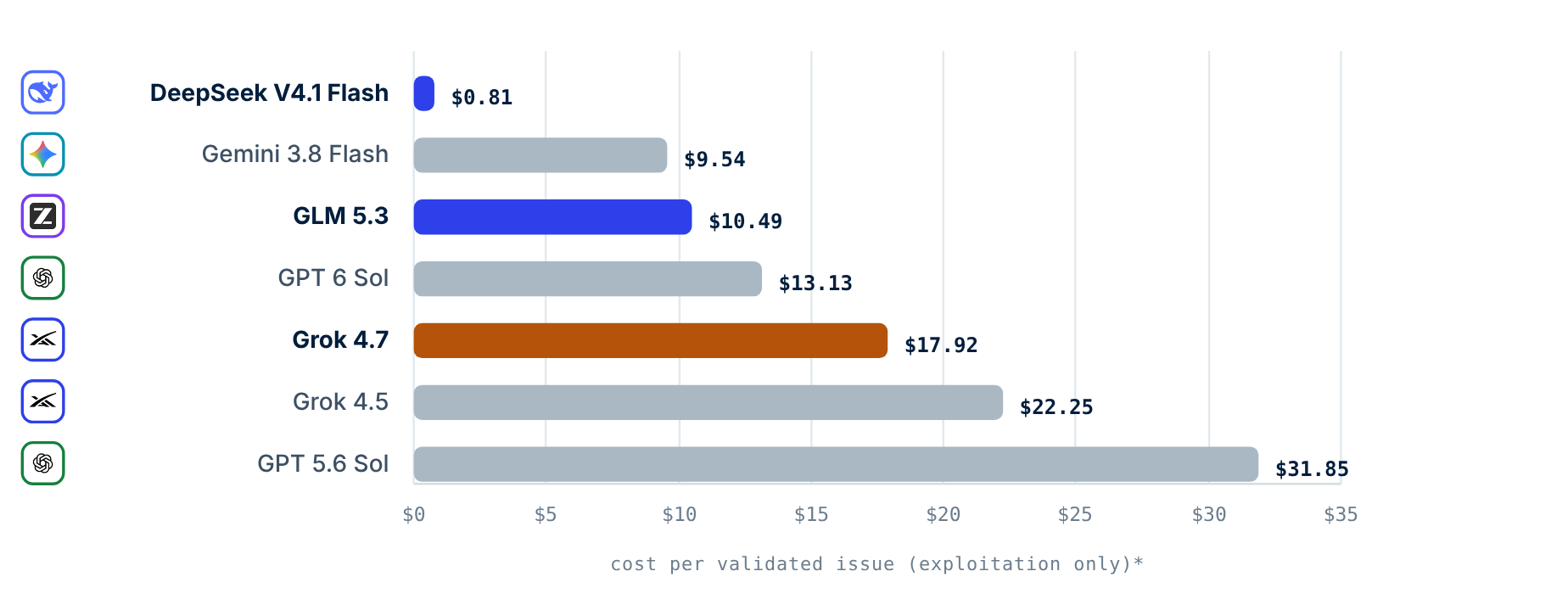
- DeepSeek cost $0.81 per validated finding. The closed models cost between $9.54 and $31.85, or 12 to 39 times more.
- Offensive security work on the newest Claude and GPT models sits behind approval programs. Even with approval under Anthropic’s Cyber Verification Program, our Claude pilots hit content filters on about half their calls. Offensive testing requires the Red Team tier, which takes weeks to approve.
- The cheapest, most effective AI attacker available today is a Chinese open-weight models that anyone can download. The frontier models that defenders use to defend themselves are far more expensive, find less flaws, and are more restrictive.
How We Tested
We built this benchmark on ARENA, our open-source generator for test targets. You give it a set of capabilities and it builds a working, containerized web application with planted vulnerabilities, wrapped in the things that make a real target hard: web application firewalls, rate limiting, and hidden endpoints. Every planted vulnerability is documented and validated as reachable before the lab is created. No model has trained on these labs, because they didn't exist until we asked for them.
A Security splits exploitation across four agents, each specialized for a specific task. Each model under test ran as the engine of all four, at high reasoning effort, and worked the same frozen set of 100 leads. A lead is a slice of the attack surface paired with the tactics to try on it, such as one endpoint tested for SQL injection. Each model ran the workload three times.
For testing, we deploy medium-sized labs with 14 vulnerabilities each and review the results. Agents run 3 times on each lab. A finding only counts once it has been reproduced, confirmed by an external judge model, and matched to a distinct vulnerability in the answer key. Repeats count once.
The charts below use a few terms worth defining up front:
- Lead: One assignment for the AI attacker, such as "try SQL injection on the login page." A lead can cover a few related pages and more than one attack technique.
- Recall: How many of the known vulnerabilities a model found in a single run. A recall of 93% means it found 93 out of every 100.
- Pass@3: How many of the known vulnerabilities a model found at least once across three tries. A model that finds different flaws each time scores higher here than on recall.
- Cost per finding and per lead: What it cost to run the model, divided by the number of real vulnerabilities it found, or by the number of assignments it worked through.
- Minutes per lead: How long the model spent thinking through one assignment, not counting time spent waiting.
- Advisor: Another model the attacker agent can ask for help when it gets stuck that may suggest different, more creative approaches and payloads, the way a junior tester might ask a senior colleague.
- Drift: How often a model reported a flaw outside what it was asked to test. The flaw may still be real, but the model went off task.
- Fallback: How often a model couldn't or wouldn't answer, so a backup model had to step in.
Open-Weight Models Found the Most
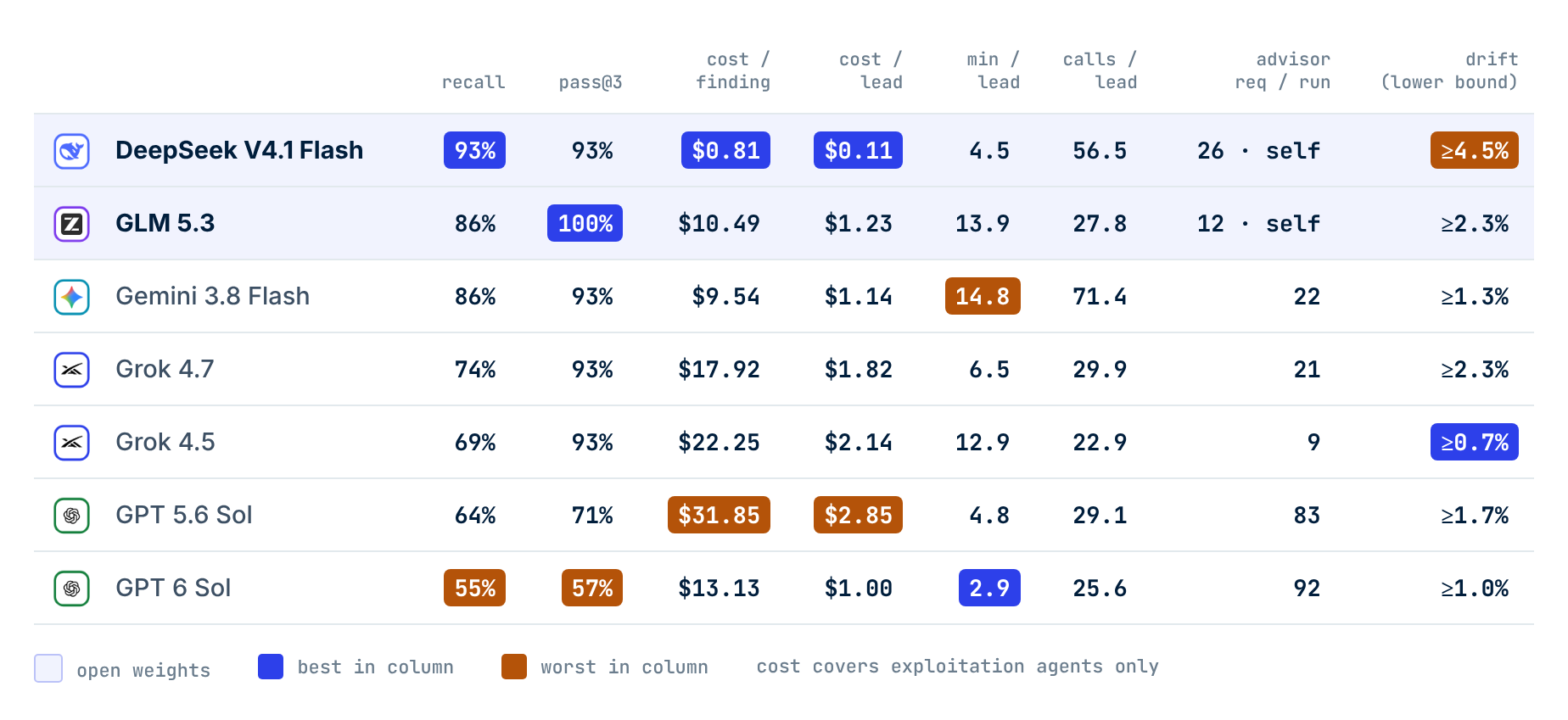
DeepSeek V4.1 Flash found the same 93% of the answer key in every run. GLM 5.3 averaged 86% and reached 100% across three runs, so it explores differently each time and covers everything in aggregate. Gemini 3.8 Flash had the highest recall of the closed models, at 86%. The two GPT models came in last, with GPT 6 Sol finding 55% per run and 57% across all three.
The two open-weight models help an attacker in different ways. DeepSeek finds nearly the same flaws every time, so one run shows most of what it will ever find. GLM varies from run to run, which means an attacker who runs it three times comes away with every vulnerability while a defender running a single scan sees only part of the picture.
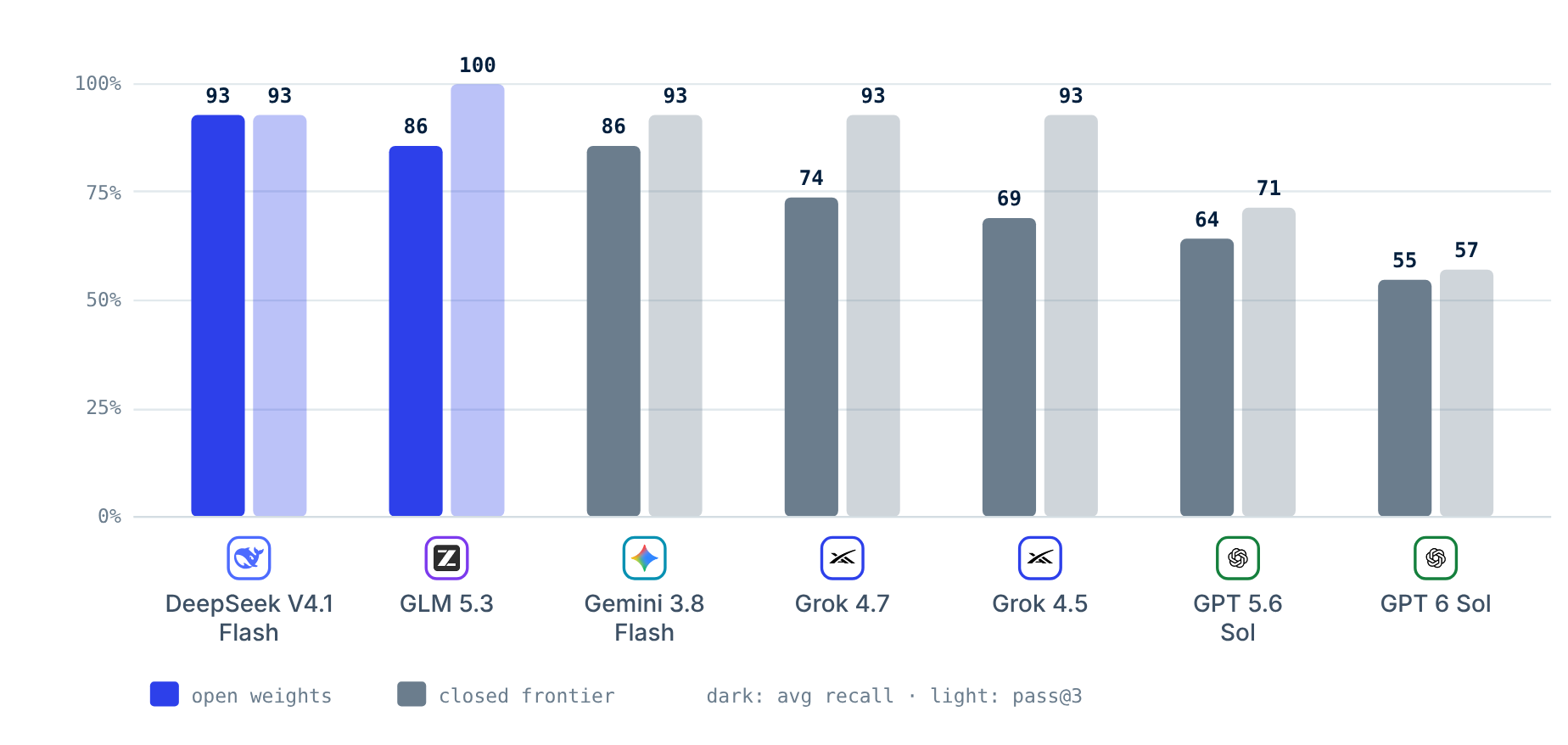
Three months ago the UK AI Security Institute put the leading open-weight models four to seven months behind the closed frontier on cyber tasks. We didn't score the closed frontier models, so this study doesn't contradict that finding. What it shows is the reality defenders face: the two open-weight models we tested matched or beat every closed model most security teams can actually use on coverage, and DeepSeek did it at a fraction of the cost.
Anthropic’s evaluation points to a similar shift in exploit-development capabilities: GLM-5.3 produced end-to-end exploits in 50 of 410 ExploitBench attempts, compared with 56 for Claude Mythos Preview. On Anthropic’s internal Binary Exploitation benchmark, GLM-5.3 achieved full control-flow hijacks in 4% of trials, compared with 6% for Claude Mythos Preview. These tests measure different tasks from ours, but suggest GLM-5.3 is nearing Mythos-level performance on some exploit-development evaluations, with publicly available weights.
DeepSeek Cost a Fraction per Finding
We divided what the four exploitation agents spent in a run by the validated findings that run produced. DeepSeek V4.1 Flash came in at $0.81. Gemini 3.8 Flash and GLM 5.3 sat together near $10. Grok 4.7 cost $17.92, and GPT 5.6 Sol $31.85. Per lead, the gap holds: DeepSeek spent $0.11, while the closed models spent between $1.00 and $2.85. At under a dollar a finding, cost stops limiting how many targets an attacker can try, and mid-size companies that were never worth an attacker's time now are.
DeepSeek averaged about 57 model calls per lead, two to three times more than most models in the set, second only to GPT-6 Sol. In this benchmark, its path to high coverage involved more calls, but those calls were fast and inexpensive. That doesn’t mean more calls are inherently better. A more capable model may reach similar results with fewer. DeepSeek’s notable combination here was high coverage, low cost, and short completion time.
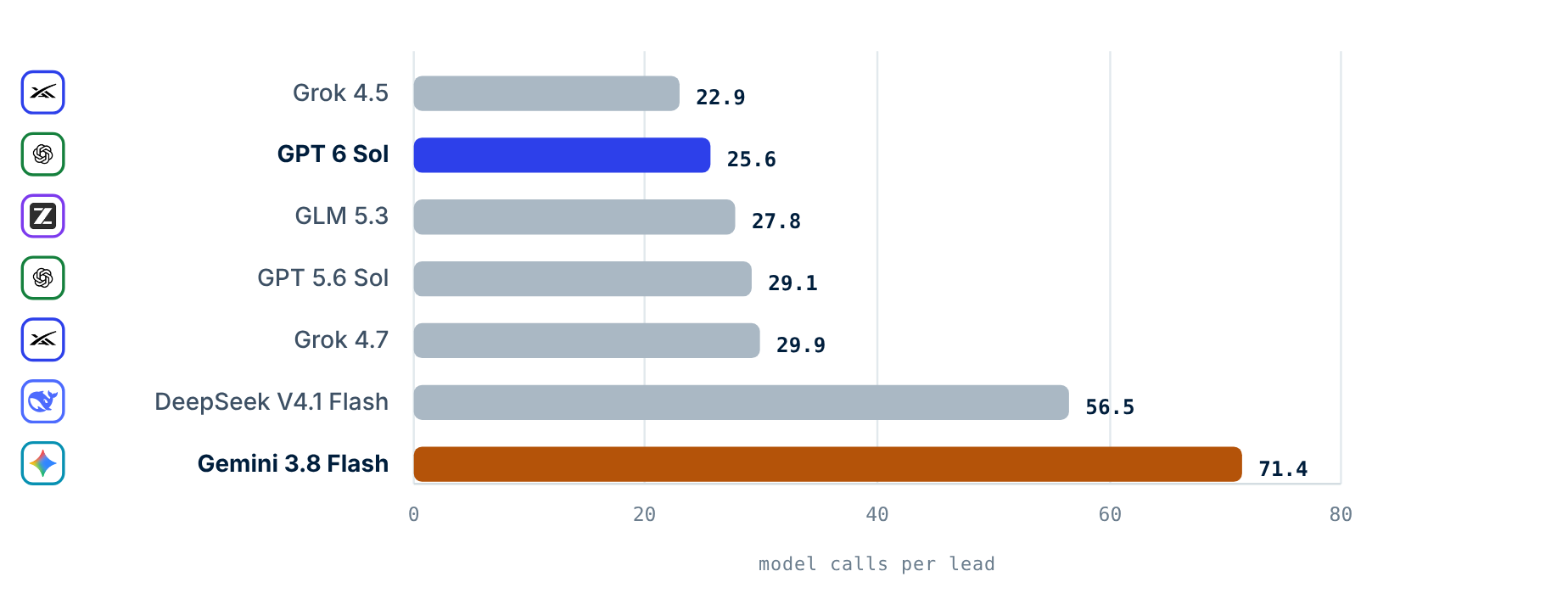
All those calls add up to about 4.5 million input tokens per lead. Most of that input is served from cache, which is why the bill stays small.

Advisor Use Varied Across Runs
DeepSeek finished a lead in 4.5 model minutes, second only to GPT 6 Sol at 2.9. GLM 5.3 and Gemini needed around 14 to 15 minutes. DeepSeek was the only model near the top on both coverage and speed. At that pace, a model can work through a large attack surface in hours, which shortens the window between a flaw going live and someone exploiting it.

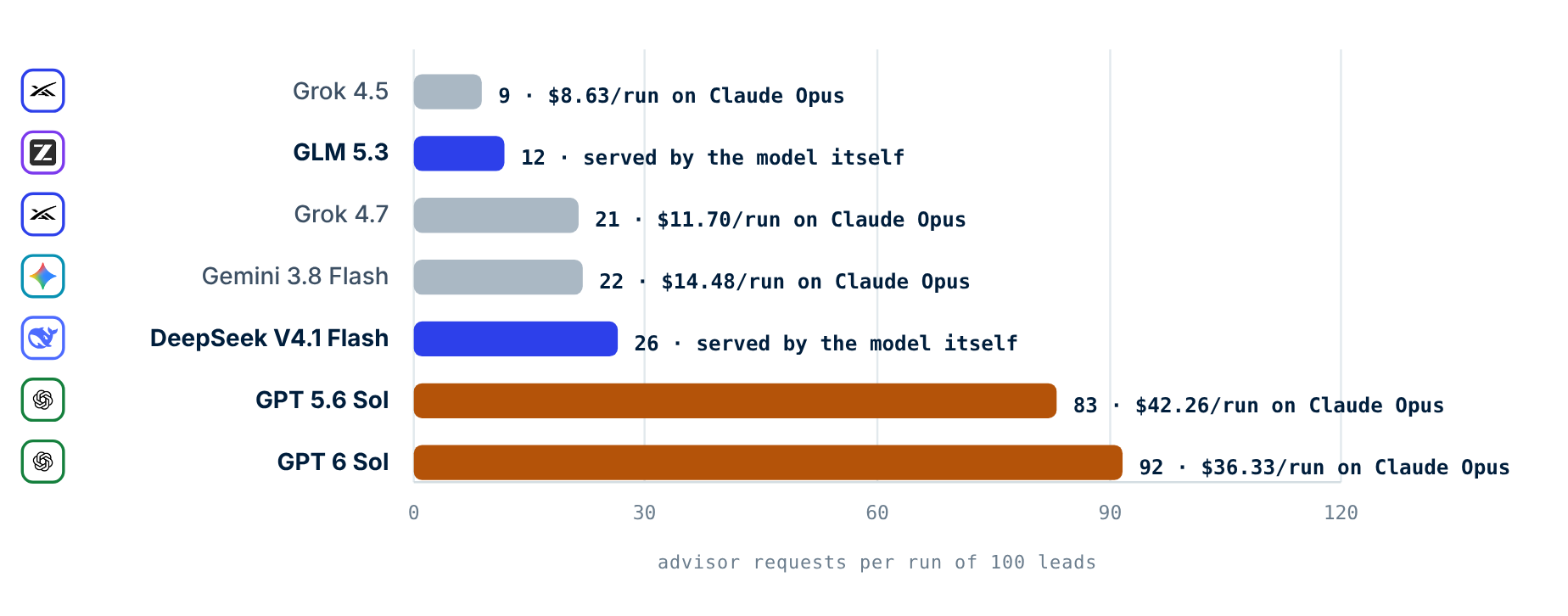
In our harness, an exploitation agent can ask an advisor for a second opinion when it gets stuck. The advisor does not have to be a different model: the same model, given a separate advisory role, can suggest another approach. The closed models consulted Claude Opus, while DeepSeek and GLM consulted another instance of themselves, keeping those configurations entirely open-weight. Because the advisor setups differed, the results compare the complete configurations, not just the underlying attacker models.
The Newest Closed Models Sit Behind Approval Programs
We scored the closed models any security team can sign up for and use today. The newest frontier models work differently. Anthropic limits offensive security work on its latest models to organizations approved for the red-team tier of its Cyber Verification Program, a review that can take several weeks. OpenAI keeps GPT-6 Astra's most advanced cyber capabilities to a small group of partners. A team that wants to test with either has to apply first and wait, while an attacker downloads the weights and starts.
A Security ran Claude Sonnet 5.5 and Opus 5.5 through Anthropic's program in one-lead pilots to see how they hold up on exploitation work. Content filters blocked so many calls that a fallback model had to answer 48% of Sonnet's and 50% of Opus's, so we left both out of the scored runs. Every model in the results stayed under 3% fallback. A security test that loses half its calls stalls or comes back incomplete, and that's what we got from the newest models even with cyber approval.
Those programs exist for good reasons. They also mean the strongest closed models reach defenders slowly, if at all.
Attackers don't apply for verification. They download the weights.
Every Result in One Table
The charts above split the results by metric. Here's the full set side by side, with the two open-weight models first.
What This Study Doesn't Show
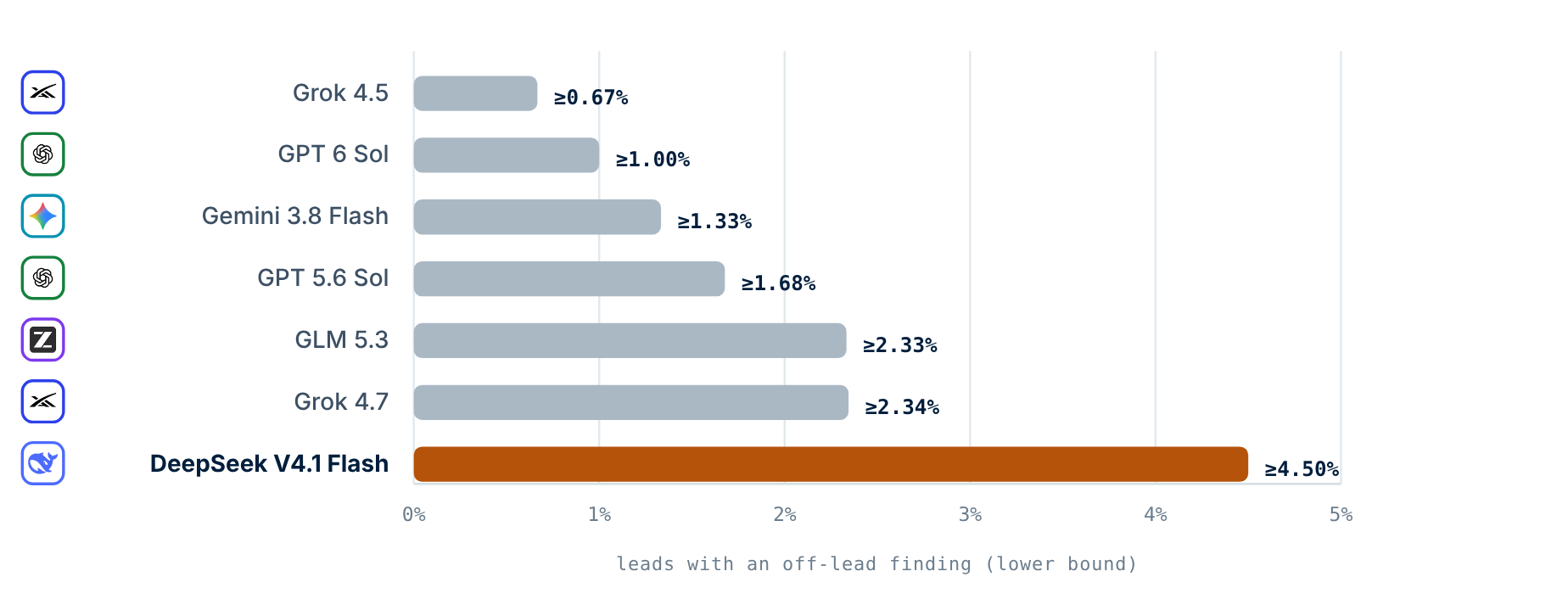
Cost covers the four exploitation agents only. To keep the cost comparison focused on the four primary exploitation agents, we exclude discovery, browser use, reporting, advisor calls, and other orchestration costs. Advisor configuration varied across runs, so including those costs would not be an apples-to-apples comparison. A full scan costs more and will vary by setup. GLM 5.3 is priced at its official token rates while the other models use recorded provider spend. DeepSeek ran on a pinned provider route, after earlier runs through another provider had heavy fallback. Reported timings reflect the inference providers and configurations used in these runs. They shouldn’t be treated as fixed model-level speed rankings, since performance may differ with another provider or serving configuration. DeepSeek also drifted the most, reporting findings from outside its assigned lead on at least 4.5% of leads, against under 2.5% for the rest. For an attacker, drift barely matters, since a real flaw is a real flaw wherever it turns up. For defenders, drift raises a scope-control concern: an agent that strays from its assigned lead may test endpoints or assets outside the engagement’s authorized scope. We didn't score precision in this run.
What Defenders Should Do Now
Planning around the attacker in this study means assuming its model is open-weight, cheap and free of any usage restrictions. Three steps follow from that:
- Evaluate against realistic attacker capabilities: Include open-weight models in security evaluations where permitted, rather than relying only on closed-model benchmarks.
- Ask vendors how they select models: Find out how they choose models for different attack techniques, combine their strengths, and evaluate new releases.
- Compare tools on a target nobody has seen: ARENA is open source under MIT, so you can generate as many labs as necessary, give the same target to every vendor, and compare the results side by side.
A New Baseline for Security Testing
The attacker most organizations will face this year doesn't need a frontier model or anyone's approval. In our tests, two open-weight models matched or beat every generally available closed model on coverage, and DeepSeek did it for under a dollar a finding. A security program that measures itself only against closed models is preparing for a weaker opponent than the one it's likely to meet. New open-weight models come out every few weeks, so that baseline keeps moving.
If your team is ready to test against the attacker you'll actually face, learn more about A Security.