
Continuous Internal Infrastructure Testing finds the misconfigurations, leftover permissions and vulnerabilities an attacker could chain together inside your network, and shows how one compromised account could lead to control of your domain.
The perimeter is only half of the picture. Most security teams test it and their internal network as separate projects. Nobody sees the full route an attacker takes from the first foothold to the domain controller. A Security already tests the way in, across external infrastructure and applications.
Today we're launching Continuous Internal Infrastructure Testing in early access. It's autonomous internal network penetration testing that starts from a single domain or unauthenticated user: our agents map your network, test the routes an attacker would take and link what they find into attack chains your team can break. The same platform now tests both halves of the route, from the way in to everything an attacker can reach once they're inside.
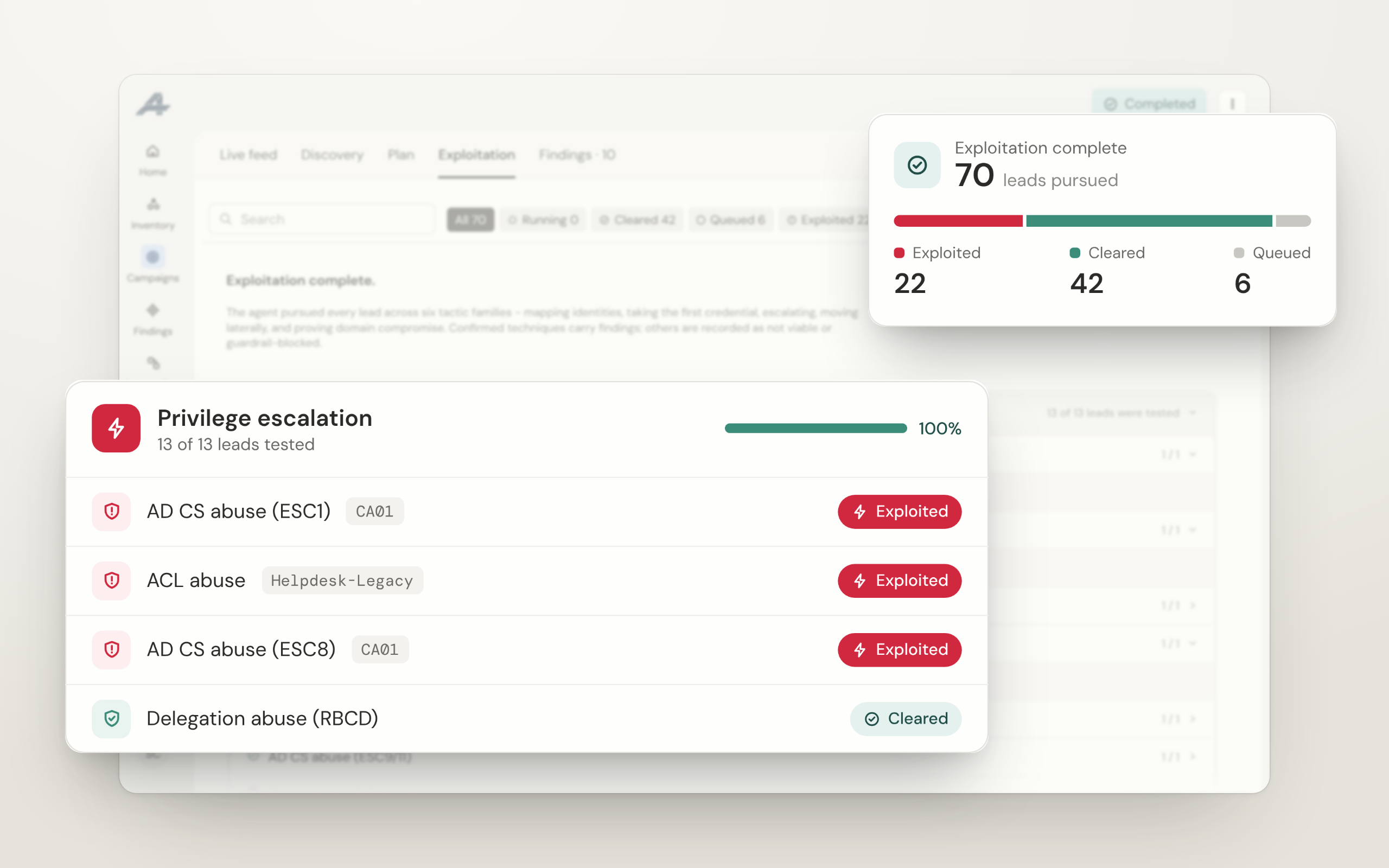
Point-in-Time Internal Network Pentesting in the AI Era Isn't Sustainable
Internal testing usually runs on its own cadence, often with a different team or vendor than the one testing the perimeter, and the network gets a pentest once or twice a year. Results come back in separate reports. Each vulnerability is scored on its own. Remote sites wait for someone to fly out or send a drop box, and many never get tested at all.
Scoring findings one at a time has a cost. A medium finding that opens the way to domain admin gets the same priority as one that leads nowhere, and the findings that matter most sit in a backlog for months. Security tools are split the same way: vulnerability management sees missing patches, identity tools see permissions and cloud tools see configuration, but none of them shows how one weakness leads to the next.
Attackers don't respect those boundaries. Binance's postmortem on its $6.3 billion theft shows how it plays out. A tampered developer tool and a fake job interview gave attackers an engineer's laptop, and endpoint security missed the malware. From that laptop, they used an internal AI tool to take over two more engineers' computers and reach the wallet infrastructure. No single report would have connected those steps.
Attackers now use AI at both ends of that route. Earlier this month, Microsoft reported that cybercriminals are using ARTEX, an open-source agentic pentesting framework, against financial organizations. In the attacks Microsoft observed, ARTEX agents scanned and exploited internet-facing systems and downloaded remote-access tools. The attackers then used those tools for persistence and lateral movement.
AI agents also adapt when security tooling blocks them. In our research lab, our agents get past hardened, prevention-mode EDR by changing their approach every time they're blocked. As networks change and attackers' tools improve, a pentest once or twice a year only shows the routes that were open on the days it ran.
How Assumed Breach Testing Works, From One Domain User to Domain Admin
Our agents already test your external infrastructure the way an attacker would, and what they find there ends in a foothold: a stolen sign-in or code running on an exposed server. Continuous Internal Infrastructure Testing picks up from there, inside the network, with a standard domain user. That's the access a phished employee or a stolen password gives an attacker, and it's all our agents get. A lightweight broker connects the agents to your network. You can run it as a container or VM, or install a standard proxy binary on a host you choose.
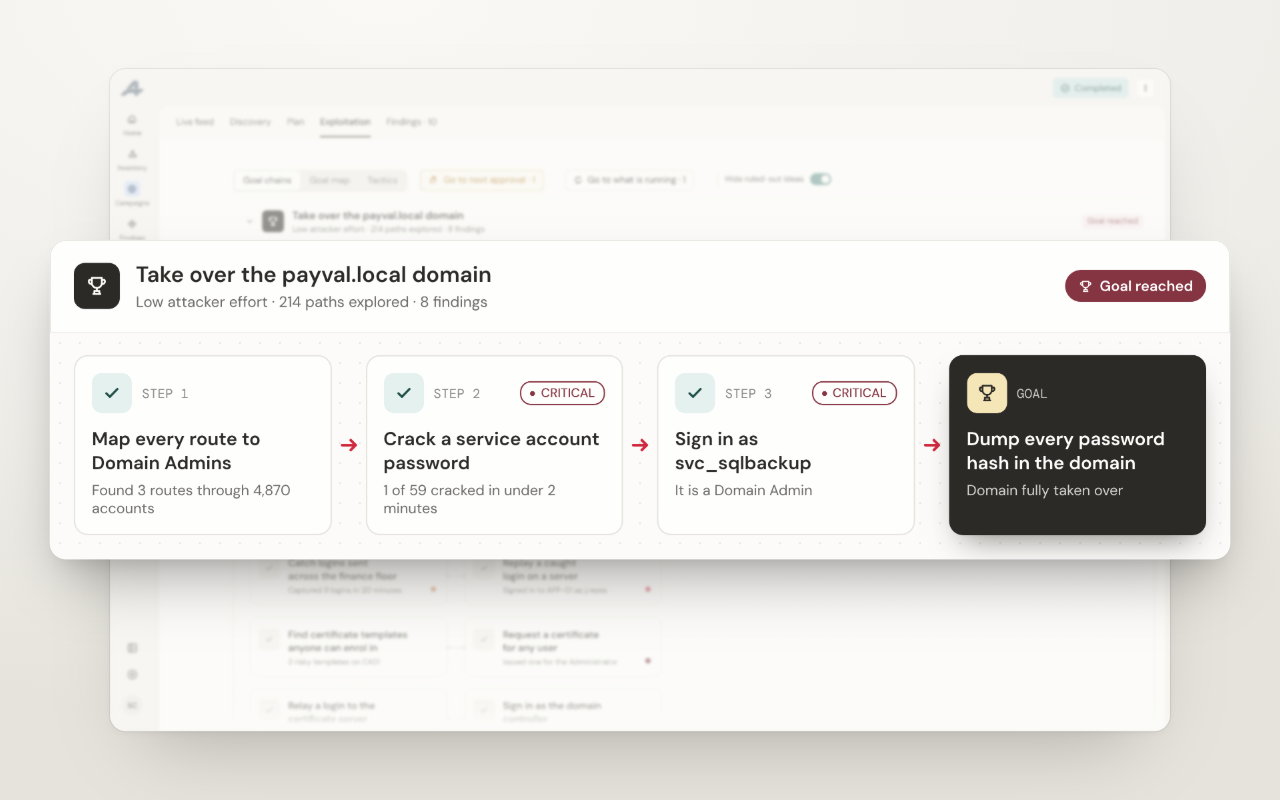
From there, the agents map the hosts and identities around them, including which accounts sit in which groups, which machines trust each other and where privileges have piled up over the years. Then they plan. Each attack is tailored to the environment they've mapped and aimed at goals, like full control of the domain, using techniques chosen for what's actually there rather than a fixed playbook. Every step maps to MITRE ATT&CK.
The result is a set of validated, exploitable attack chains. Each finding links to the steps before and after it, from the starting account to domain admin. This includes weaknesses that have no CVE, which vulnerability scanners don't report. A medium finding on a critical attack chain doesn't look like every other medium finding. Your team knows to fix it first. Every run comes with automatically documented evidence: screenshots, the commands the agent ran, the privilege it gained and the business systems at the end of the chain.
Safe Internal Network Testing on Production, Within Limits You Set
Continuous testing should run on the live network, because that's where the real routes are. Some of the systems there can't afford to go down. You decide where the agents go. Mark a system off limits, like a medical device or a fragile production server, and the agents stay away from it. High-impact steps, such as escalating privileges in Active Directory, wait for your approval before they run.
Underneath those settings, every action passes through A Security's Layered Guardrails, which the agents can't argue their way past:
- Check every task before it runs: Each exploitation task is reviewed against your safety policy, and an independent judge checks every action that changes state.
- Enforce hard limits: Scope limits block anything outside your approved targets, and denial of service and data destruction stay blocked at every setting.
- Stay in control: Rate limits apply to every test, and a kill switch is always available.
- Keep a record: Your SOC can match every alert to a timestamped, logged action, and your auditors can review every intervention.
For regulated environments, the platform can also run in your own cloud account on AWS, Azure or Google Cloud, air-gapped if needed, with every AI call going to a model you've approved.
What Happens After an Internal Attack Chain Is Found
Each chain goes to your security team with the full route, the evidence for every step, its ATT&CK mapping and a recommended fix at the identity, host or network layer. Findings can open as tickets in the tools your team already uses, or go to a coding agent when the fix lives in code, such as infrastructure-as-code or deployment scripts. Because the findings are linked, your team works on the single change that cuts the chain.
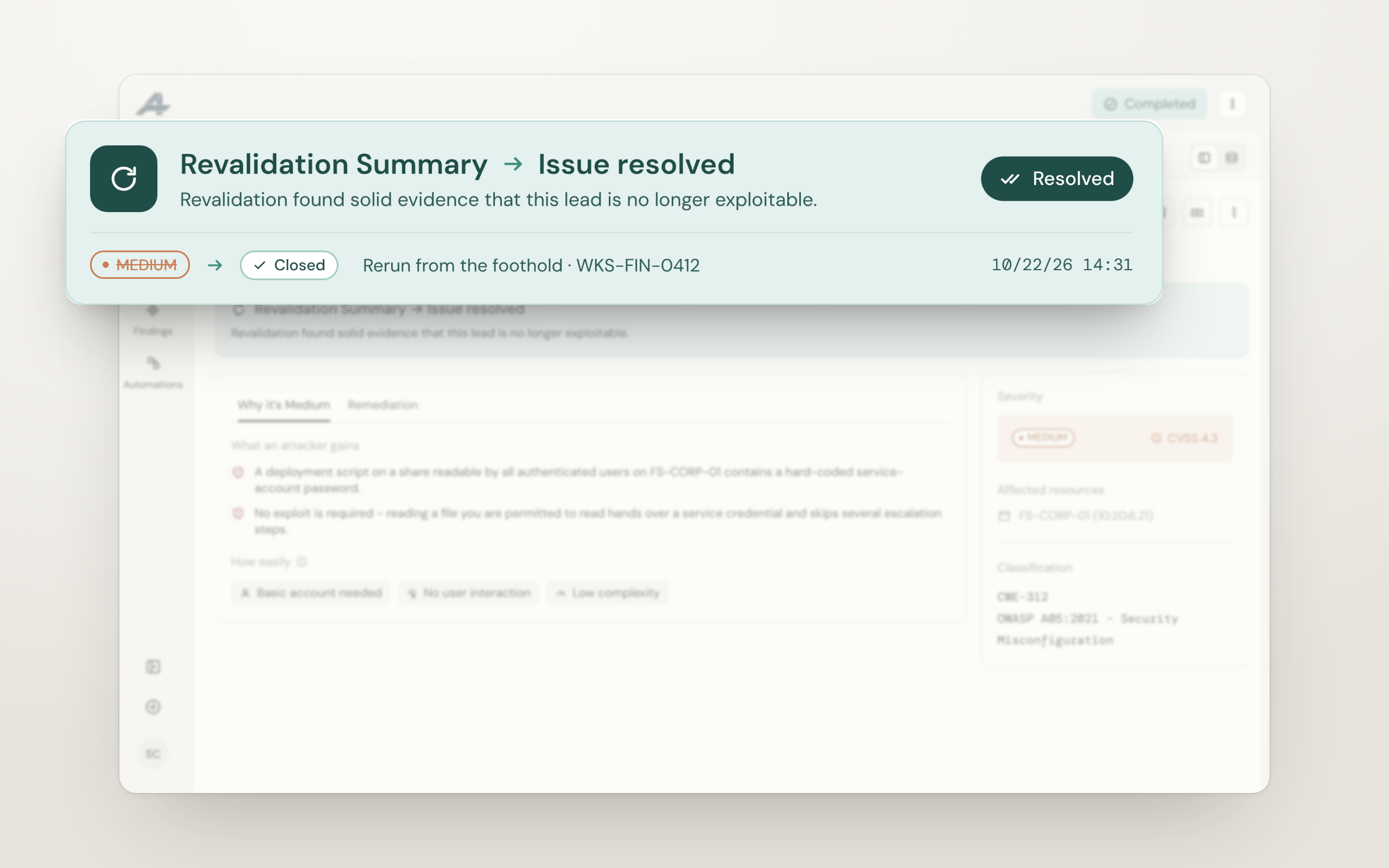
Internal fixes are rarely a one-line change. Once the work is done, the agents rerun the same attack path from the original account and confirm whether the chain is actually broken.
See What One Account Can Reach With A Security
Continuous Internal Infrastructure Testing is available now in early access for Active Directory environments. It runs on the same autonomous offensive security platform that already tests your external infrastructure and applications.
Our agents start from one domain user. They run the routes an attacker would take, within limits you set, and prove which ones work. Every finding links to the chain it belongs to, including the weaknesses that have no CVE. Every fix is retested from the same account. Your pentesters and red team get a current starting point for every engagement.
To start, we need an Active Directory domain, one standard domain user account and a contact on your network team to help connect the agents. If your team is ready to find what one compromised account can reach before an attacker does, request early access to A Security's Continuous Internal Infrastructure Testing.