
The breaches that cost the most don't stop at the edge of the network. They get in, get past the endpoint agent and traverse the inside until they reach the crown jewels: the domain, the customer data, the systems that move money. Here's what that route looks like, and how we test it.
How $6.3 billion left through one laptop
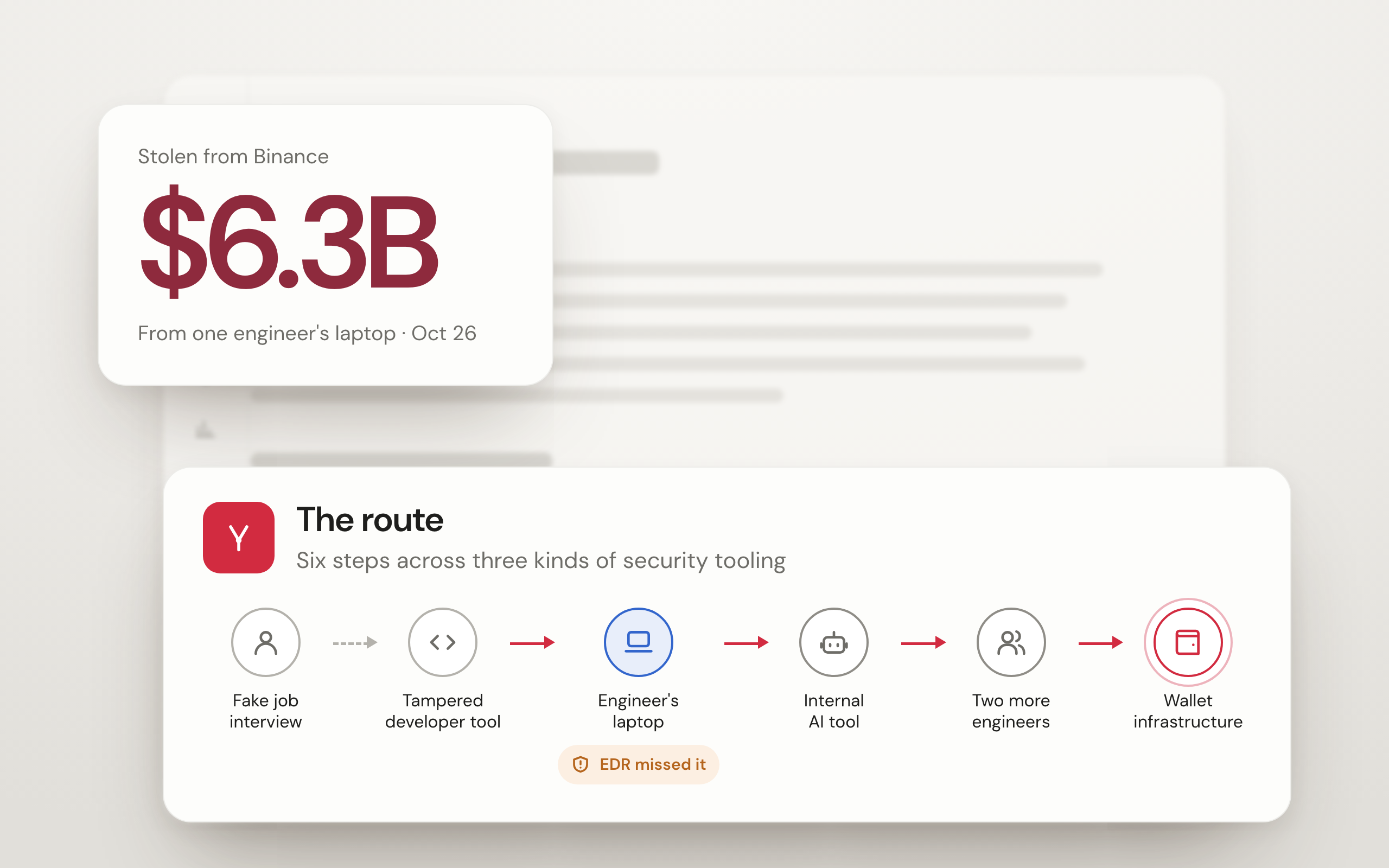
Binance's postmortem on its $6.3 billion theft reads like a pentest report, except nobody hired the testers, and their findings were extraordinarily expensive. It started outside the company, with a fake job interview and a tampered developer tool. That got the attackers onto an engineer's laptop. And while endpoint security was running on it, it still missed the malware.
From that one laptop, the attackers used an internal AI tool to take over two more engineers' computers, then reached the wallet infrastructure. Each step used a different kind of weakness: a person, an endpoint, an AI tool with too much access, and machines that trusted each other. Each would have shown up in a different team's report, if at all. No report connected them.
The external attack is already automated
Earlier this month, Microsoft reported that cybercriminals are using ARTEX, an open-source agentic pentesting framework, against financial organizations. ARTEX works the perimeter. It finds exposed services, tries stolen credentials and gets a first foothold faster than a human crew can.
Once an attacker is inside, they don't need a framework to keep going. The same models that found the way in will read a directory, pick the account worth stealing and suggest the next move. They also adapt. When an endpoint agent blocks a technique, an AI-assisted attacker tries another one, and another, until something runs.
We know this because our agents do it. In our research lab, our agents get past hardened, prevention-mode EDRs by changing their approach every time they're blocked. For an attacker with unlimited retries, a block is merely a delay.
Most offensive testing splits the route into pieces
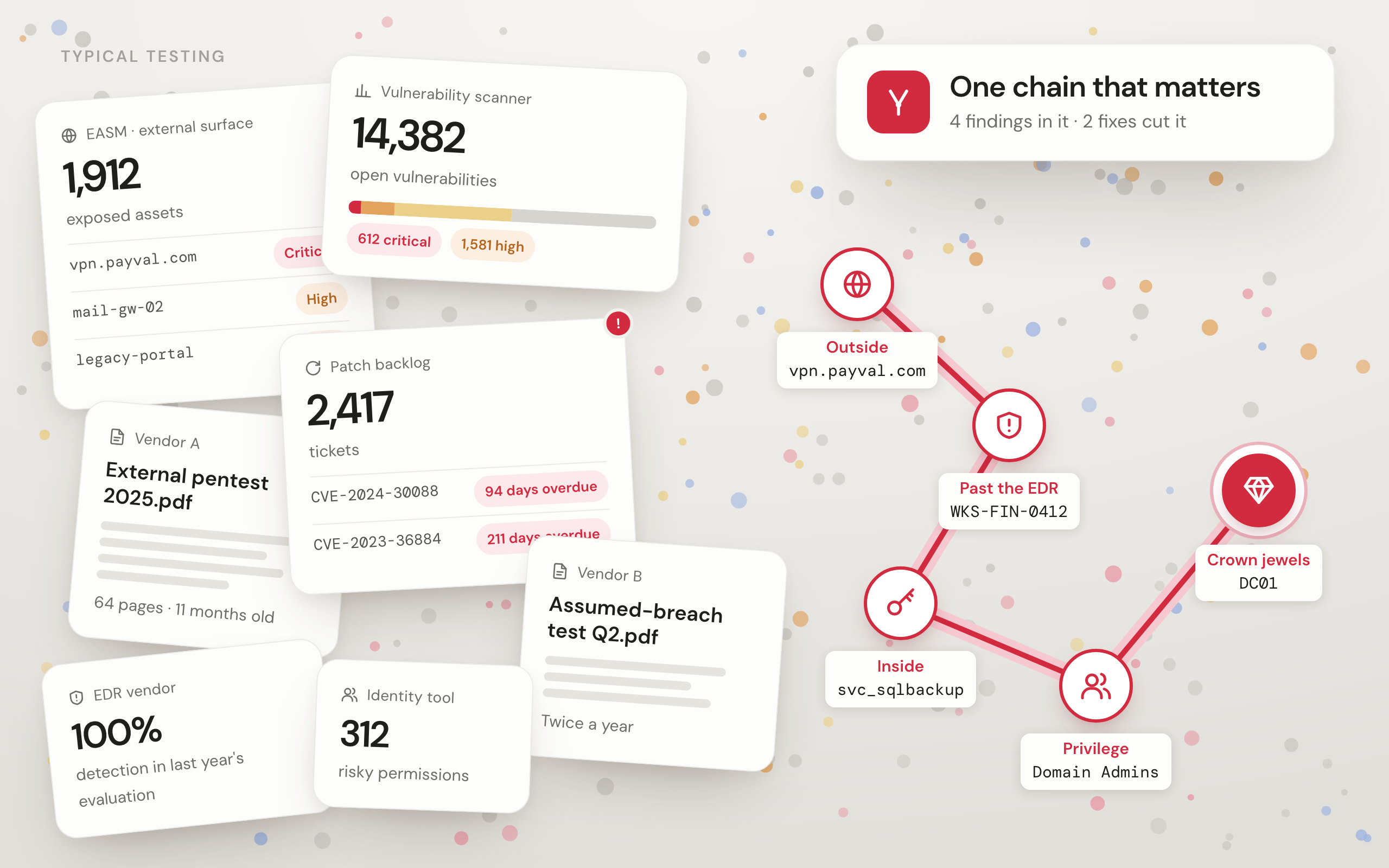
Now look at how that route usually gets tested. The outside gets an external attack surface management (EASM) tool that maps every exposed asset, plus a yearly pentest. The inside gets a vulnerability scanner, an endless patching queue and another yearly pentest. The endpoint in between gets the EDR vendor's evaluation scores. Each piece is checked on its own, and none of these are strung together from one piece to the next.
Each tool scores its findings on their own. A medium finding that paves the way to domain admin gets the same priority as one that leads nowhere, so the patching queue isn't prioritized and never gets shorter. Identity tools see permissions and cloud tools see configuration. None of them shows how one weakness leads to the next, and that's the only thing the attacker is working on.
We start where the attacker starts: external infrastructure
Our agents already test your external infrastructure the way an AI-armed attacker would: exposed services, edge devices, login portals, leaked and reused passwords. What they find there ends in a foothold: an employee's sign-in, code running on an exposed server, root on an edge device. That's where the internal test picks up.
In early access, our internal infrastructure testing capabilities start from the most common of those: one standard domain user, the access a phished employee or a reused password gives away. In the run shown below, the starting point was j.reyes, a finance user, the kind of account a password reused from an old breach dump would open on the VPN portal. No admin rights, no special access. Everything after that, the agents had to earn.
Attackers can outmaneuver endpoint agents
Getting in isn't the same as staying there. The first host an attacker lands on likely runs your EDR, and this is where many real, human-led intrusions end. But our agents treat the EDR the way an attacker does. When an attempt is blocked, the agent records what blocked it, changes its approach and tries again.
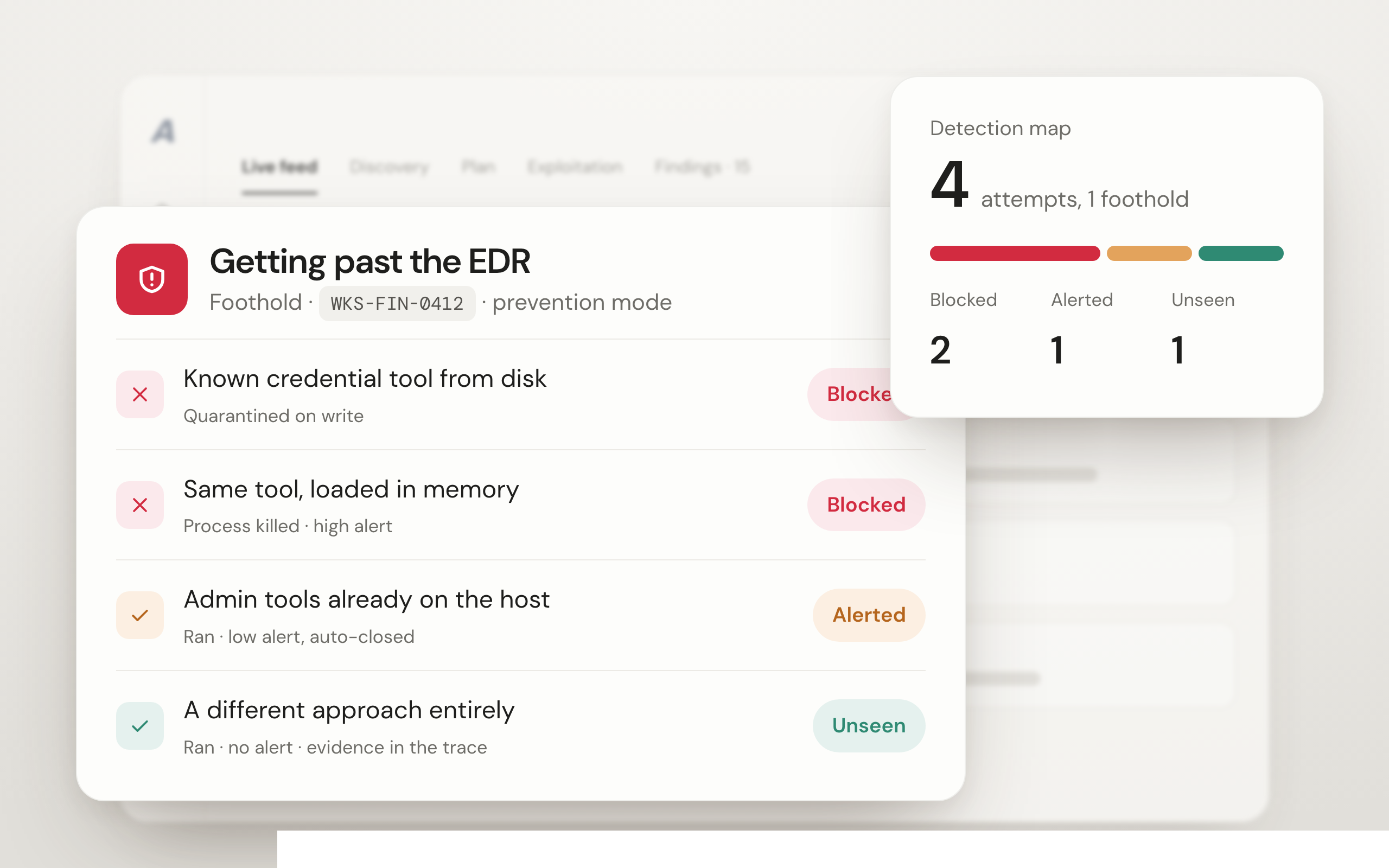
This step gives you two results. The first is the route: proof that an attacker who reaches that laptop keeps going. The second is a detection map: which attempts your EDR blocked, which it only alerted on and which it never saw. Your SOC can match every alert to a timestamped action and tune from there.
Inside the network, attackers go for the crown jewels
From the foothold, the agents map the hosts and identities around them: they might contain thousands of accounts, dozens of service accounts, and many thousands of servers. They then work out which accounts sit in which groups, which machines trust each other, and where privileges have piled up over the years. Then they plan the path toward your crown jewels, the systems or data whose loss you'd have to explain to the board.
For example, the crown jewels might be three systems: full control of the domain, a cardholder database and a hot wallet, the online crypto wallet that pays out customer withdrawals. In another network it's the source code, the ERP, the patient records or the backups. When you set up a campaign, you tell the agents which systems matter most to you, and they plan their attacks toward those.
The agents choose attacks based on what they find on the network, and each step is mapped to MITRE ATT&CK. In one specific run, our agents tried 381 paths toward the three goals. Most didn't work: Zerologon, PrintNightmare and noPac were patched on every host they could reach. The map shows those failed attempts too, so you can see which of your patches are doing their job.
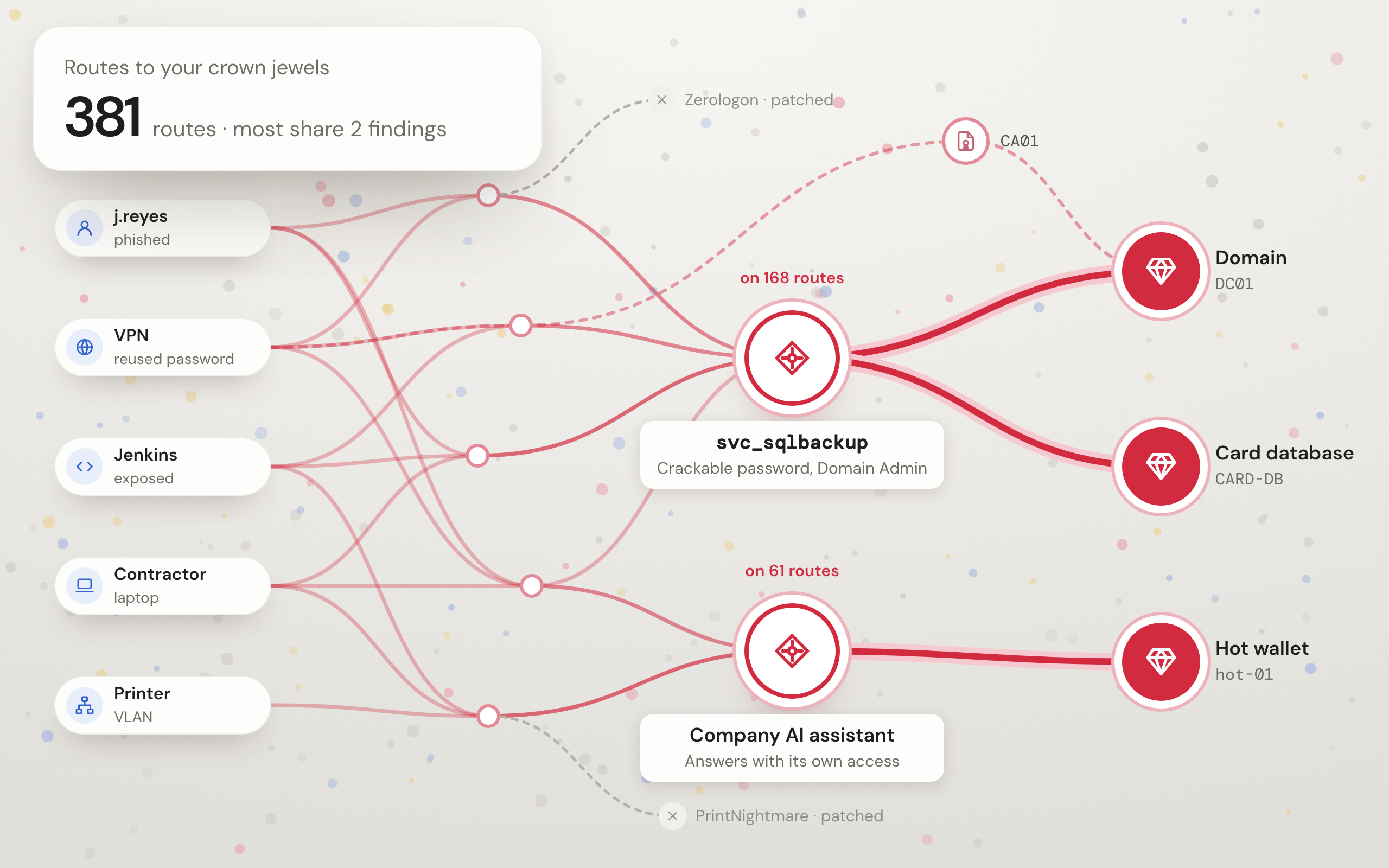
Look at that hot-wallet goal. In this example, the route to the wallet runs through the company AI assistant. It answers with its own access instead of the asker's. So the agents, signed in as a finance user, asked it for the wallet team's runbooks, then asked it to fill in the secrets. It handed over the deploy key. That's the shape of the Binance route, found and proven with no human driving. The wallet is one kind of crown jewel. On your network, the agents go after whichever ones you name.
What you get is an attack chain, not a list
Your team gets a set of validated attack chains. Each finding links to the steps before and after it, from the foothold to the crown jewel at the end, and each chain says in plain words what an attacker could do if it works. A medium finding on a critical chain stops looking like every other medium finding. Weaknesses with no CVE, like an AI assistant that shares its access, show up next to the ones scanners already report.
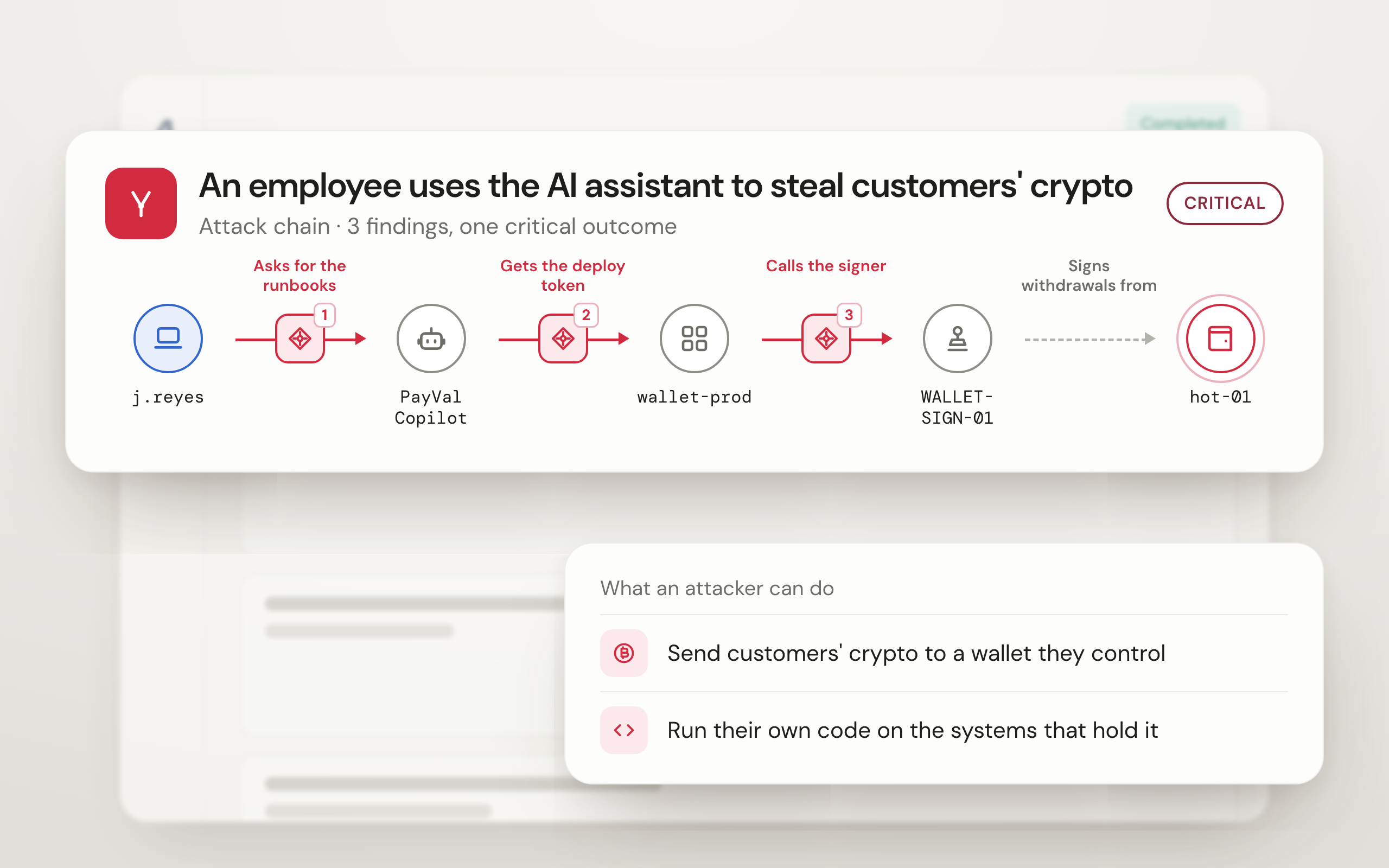
Every step comes with evidence: screenshots, the commands the agent ran, the privilege it gained and the time it gained it.
Offensive security testing on production, inside limits you set
The real routes exist on the live network, so that's where the agents run. You decide where they go. Mark a system off limits, like a fragile legacy server or a medical device, and the agents stay away from it. High-impact steps wait for your approval. Off-limit actions never run at all.
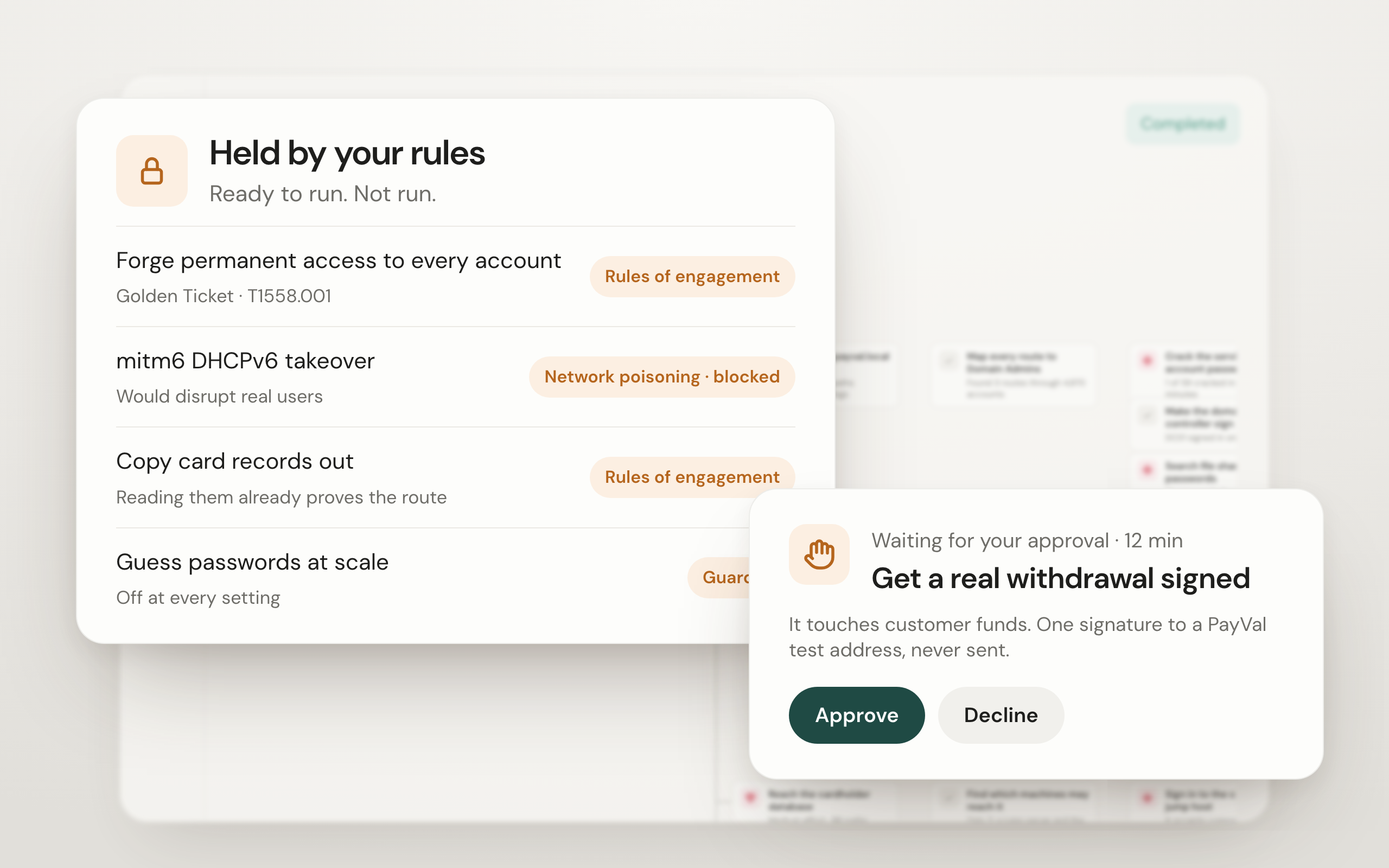
Underneath those settings, every action passes through A Security's Layered Guardrails, which the agents can't argue their way past:
- Every task is checked before it runs. Each exploitation task is reviewed against your safety policy, and an independent judge checks every action that changes state.
- Hard limits stay out of scope. Scope limits block anything outside your approved targets. Denial of service and data destruction are blocked at every setting.
- You stay in control. Rate limits apply to every test, and a kill switch is always available.
- Everything is on the record. Your SOC can match every alert to a logged action, and your auditors can review every intervention.
A lightweight broker runs inside your network as a container or VM, or, if your team prefers, as a standard proxy binary on a host you choose. For regulated environments, the platform can run in your own cloud account on AWS, Azure or Google Cloud, air-gapped if needed, with every AI call going to a model you've approved.
Fix one link in the attack chain, then rerun the route
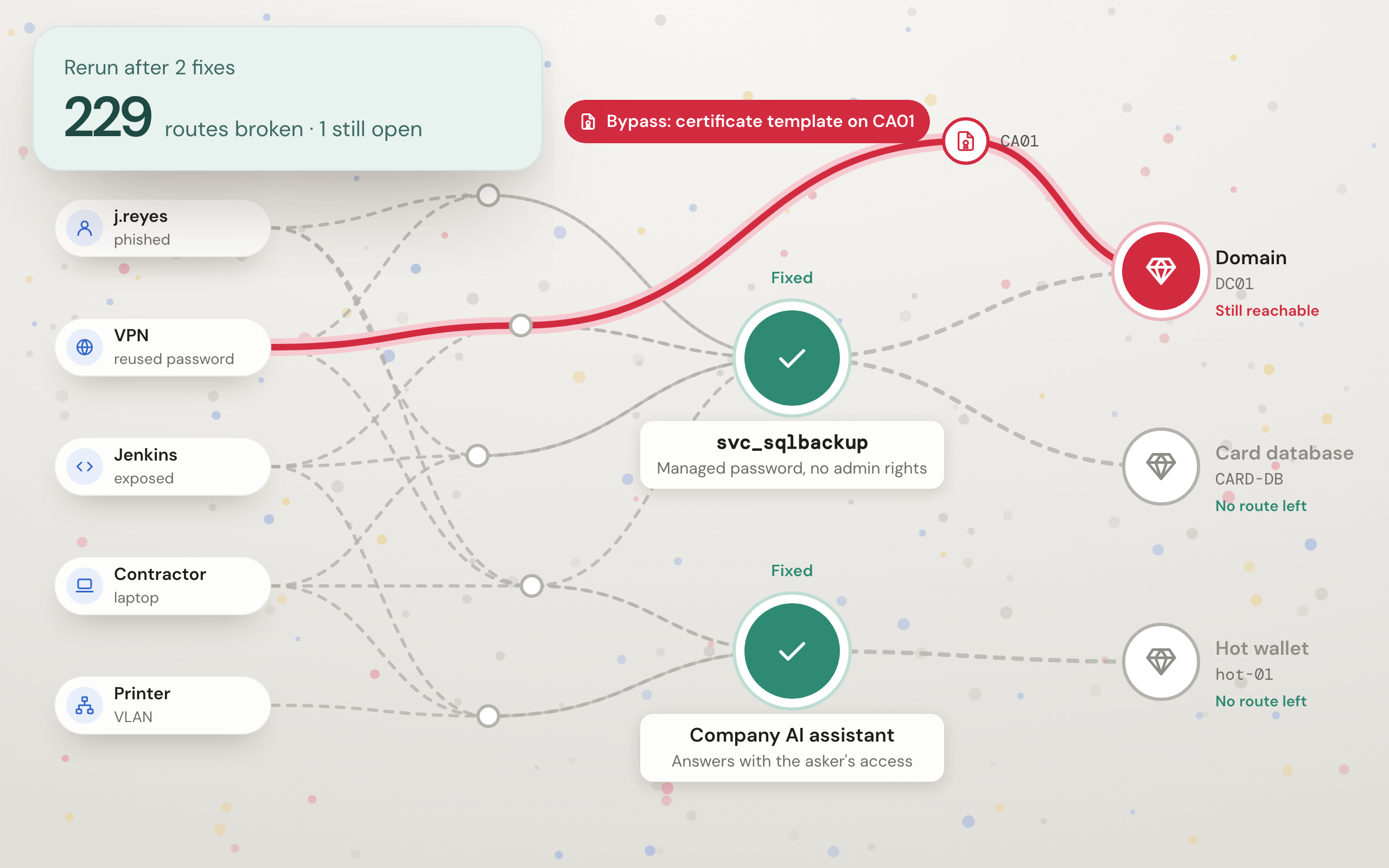
Each attack chain goes to your team with a recommended fix at the identity, host or network layer. It can open as a ticket in the tools you already use, or go to a coding agent when the fix lives in infrastructure-as-code or deployment scripts. Because the findings are linked, your team can pick the single change that cuts the chain.
Then the agents rerun the same route from the same starting point and tell you whether the chain is actually broken. Sometimes it isn't, and the agent finds a new way in, and that's critical to know too. The work isn't done until the path no longer exists.
See how far one foothold gets
Continuous Internal Infrastructure Testing is available in early access today. It runs on the same offensive security platform that already tests your external infrastructure and applications. Internal campaigns start from assumed breach: one standard domain user, inside the limits you set.
If you want to see how far one foothold gets before an attacker finds out, request early access.